
Bad Breath Treatment in Chennai: When It’s More Than a Mint
The short version
- About nine times in ten, bad breath comes from the mouth — not the stomach.
- The usual culprits are the back of the tongue and the gum pockets, both invisible in a mirror.
- Bad breath that survives brushing and flossing is a signal, not a mystery. It has a cause.
- Fruity or ammonia-like breath needs a physician, not a mint.
Bad breath has an unfair reputation. People assume it is about hygiene, or something they ate, so they reach for a mouthwash and hope. But if it is still there after you brush and floss, the smell is coming from somewhere specific, and the mouthwash was never going to reach it.
Most bad breath treatment in Chennai starts with the wrong question. The useful question is not “which mouthwash” but “where is this coming from”. This page walks through exactly that, because the answer decides whether you need a dental cleaning, a gum specialist, or a physician.
Where bad breath actually comes from
Roughly 85 to 90 per cent of bad breath originates in the mouth. The other 10 to 15 per cent comes from the nose, throat, stomach or bloodstream. The distinction matters because treating the wrong source is why most people keep their bad breath for years.
| Source | What it smells like | Where it is fixed |
|---|---|---|
| Tongue coating | Sour, musty | Tongue cleaning, at home |
| Gum pockets | Rotten, metallic | Periodontal treatment |
| Decay / old fillings | Localised, food-like | Filling or crown |
| Tonsil stones | Rotten egg | ENT referral |
| Post-nasal drip / sinus | Stale, thick | ENT or physician |
| Acid reflux | Sour, acidic | Gastroenterologist |
| Diabetes (ketones) | Fruity, nail-polish | Physician, urgently |
The 60-second test you can do at home
- The wrist test. Lick the inside of your wrist, wait ten seconds for it to dry, then smell it. That is roughly what your breath smells like.
- The floss test. Floss between the back molars, then smell the floss. A strong smell there points at gum pockets between the teeth.
- The spoon test. Gently scrape the back of your tongue with a spoon, let it dry, and smell it. A coating smell points at the tongue.
None of these are diagnostic, but they tell you where to point the dentist before your first appointment.
Causes people treat wrong
Tongue coating. The back of the tongue is the single biggest source of oral bad breath, and it is the one nobody sees. Bacteria break down trapped food and dead cells into sulphur compounds. A tongue scraper does more here than any mouthwash.
Gum disease. A deep pocket between tooth and gum collects bacteria and dead tissue that no brush reaches. This produces a specific rotten, metallic smell, and it is why bad breath is often the first sign someone has periodontitis without knowing it.
Dry mouth. Saliva is the mouth’s natural rinse. When it drops — from medicines, mouth breathing, or simply sleeping — bacteria multiply and morning breath appears. Chronic dry mouth needs a cause found, not just water.
Diet and tobacco. Onion, garlic and coffee linger for a day because their compounds enter the bloodstream and are exhaled. Smoking and gutkha leave a distinct stale smell and, worse, dry the mouth and mask gum disease at the same time.
Post-nasal drip and tonsil stones. Drip from the sinuses feeds bacteria at the back of the throat. Tonsil stones — small white lumps of trapped debris — smell strongly of sulphur and return until the tonsil crevices are cleaned or treated.
What a dentist actually checks
There is no guesswork in a proper examination. When someone comes in for bad breath treatment, we look at the mouth in a set order:
- The tongue — coating thickness and where it sits
- The gums — a periodontal chart measures pockets and bleeding, because this is the most commonly missed cause
- The teeth — decay, leaking fillings, food traps between teeth
- The tonsils — stones or chronic infection
- The mouth’s moisture — whether saliva flow is genuinely low
If the mouth is clean and healthy, the cause is elsewhere, and the next stop is an ENT or a physician rather than another round of dental treatment.
When it is a medical problem, not a dental one
See a physician if the smell has these characters:
- Fruity or nail-polish breath — a sign of diabetic ketoacidosis, and it is urgent
- Ammonia or fishy breath — can point to kidney or liver problems
- Sour, acidic breath with heartburn — acid reflux
- Recurring tonsil stones — usually an ENT referral
- Persistent cough or post-nasal drip — sinus or chest
If your breath smells sour after eating and you have heartburn, a dentist can clean your teeth perfectly and the smell will return the same evening. The mouth was never the source.
Treatment: what actually works
For the mouth-origin cases, the fix is mechanical, not chemical.
Scaling. If the cause is calculus and gum pockets, a professional scaling removes what the brush cannot. Where pockets are deep, this is followed by root planing to clean below the gum line. Most people notice the difference within a week.
Tongue cleaning. A scraper, used daily from back to front, reduces the tongue coating that causes most oral odour. This is a habit, not a one-time fix.
Repairing the source. A decayed tooth or a leaking filling holds food that rots; no mouthwash fixes it. The filling or crown does.
Referral. If the mouth is healthy, the honest answer is a referral, not another cleaning. A dentist who does not tell you this is treating the wrong thing.
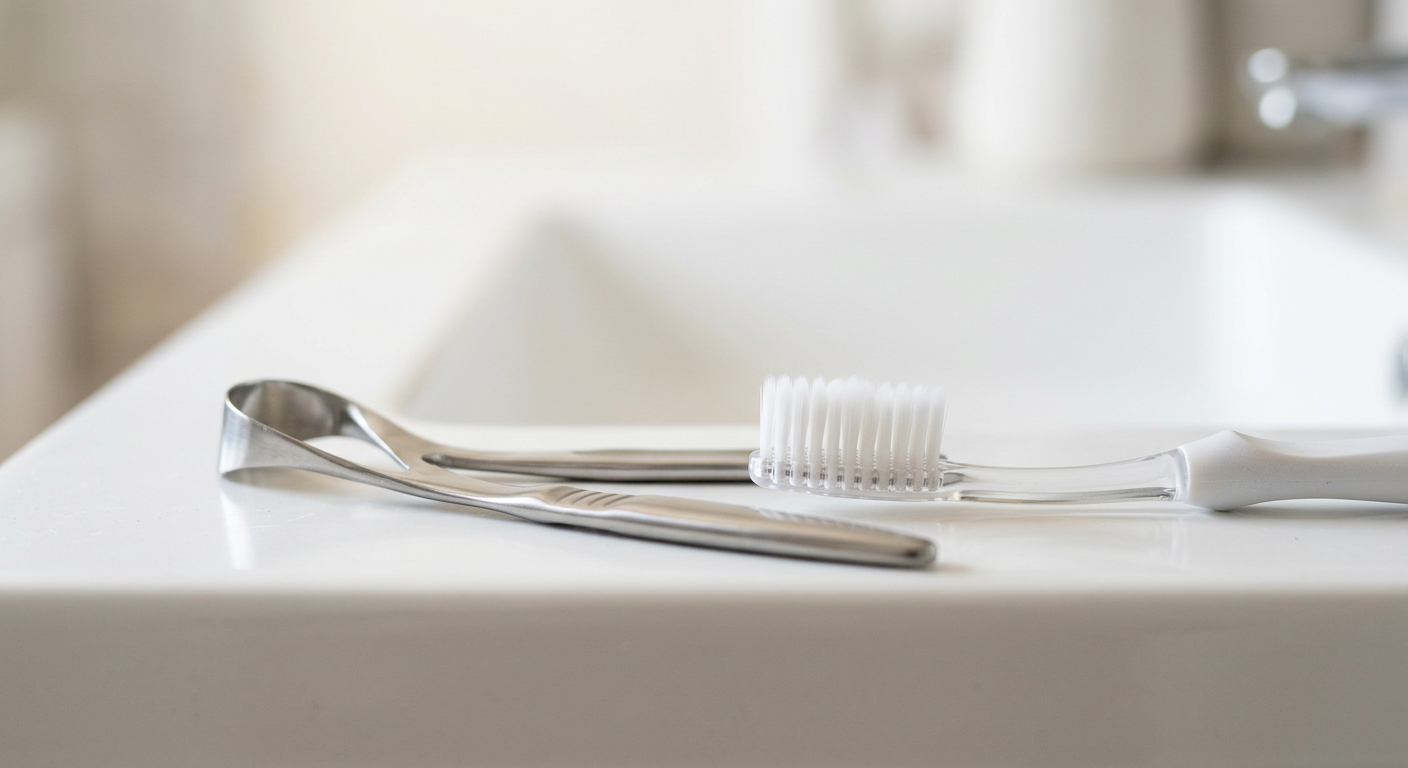
A tongue scraper and soft brush reach what mouthwash cannot. Illustration.
Home care that actually lasts
Brush twice a day and clean between the teeth once. Add a tongue scraper, and drink enough water that your mouth is not dry by midday. Mouthwash is an addition, never a replacement — it masks for minutes where the tongue and the gum line need cleaning for the day.
Do not smoke or use gutkha, and if you are on medicines that dry the mouth, mention it — there are specific rinses and habits for that.
Morning breath is not the same thing
Waking up with a stale taste is normal. Saliva flow drops while you sleep, bacteria multiply in the dry mouth, and the result is morning breath. It clears once you drink water, brush and clean the tongue.
The warning sign is when the smell is still there by mid-morning, or comes back within an hour of brushing. That is not morning breath, and it is not going to clear on its own. That distinction alone saves a lot of people a year of buying mouthwash that was never going to work.
Bad breath in children
In children, bad breath is most often the tongue, a blocked nose forcing mouth breathing, or something stuck — a piece of food or a bead lodged in the nose is more common than people expect. Gum disease is rare in children, so the same smell that in an adult points at gum pockets usually points somewhere simpler.
If a child has persistent bad breath, check the nose and the throat, and bring them in for a look before assuming it is just diet. It usually is not.
How long treatment takes to work
For tongue-coating odour, a scraper changes things within two or three days. For gum-pocket odour, the smell improves in the week after scaling, as the inflammation drops. For a decayed tooth or tonsil stones, the smell goes when the source is treated — not before.
If a treatment is working, you should notice a real difference inside two weeks. If nothing has changed by then, the source was not the mouth, and it is time to look at the nose, throat or stomach.
Medicines and conditions that dry the mouth
A long list of common medicines reduce saliva as a side effect: antihistamines for allergy, blood pressure medicines, antidepressants, and several medicines for bladder or mood. When the mouth is dry, bacteria multiply faster, and bad breath follows even in someone with perfect brushing.
If you started a new medicine and noticed your breath or your dry mouth shortly after, the two are probably connected. Do not stop the medicine on your own — the fix is usually a higher water intake, a saliva substitute or a specific rinse, and we can guide that while you continue your prescription.
Radiotherapy to the head and neck, and some autoimmune conditions, also damage or reduce the salivary glands. That kind of dry mouth is different from skipping a glass of water, and it needs a dentist involved in the long term because it also accelerates decay.
When mouthwash actually helps
Mouthwash has a real but narrow place. A short-term antibacterial rinse after scaling keeps the bacterial load down while the gums heal, and an alcohol-free rinse helps some people with dry mouth sleep better. What it does not do is remove plaque from below the gum line, clean a decayed tooth, or fix reflux.
The test is simple: if the smell returns within an hour of rinsing, the rinse was never treating the cause. Use it to support cleaning, not instead of it.
Questions patients ask
Why is my breath bad even after brushing?
Because the source is somewhere brushing does not reach: the back of the tongue, the gum pockets, or the tonsils. That is the most common pattern we see.
Can I smell my own breath?
Mostly no. Your nose filters your own constant smells, which is why the wrist and floss tests matter. People often only know from someone close to them.
Does mouthwash cure bad breath?
No. It masks for a short time. If the cause is a gum pocket or a decayed tooth, the smell returns within the hour.
Is bad breath always a dental problem?
No. Around ten per cent of cases come from the nose, throat, stomach or a medical condition. That is exactly what the examination is for — to find which category you are in.
Does cleaning my tongue make a real difference?
Yes, for tongue-coating odour it is the single most effective home measure. Use a scraper daily, gently, back to front.
Can bad breath mean diabetes?
Fruity, nail-polish-smelling breath can be a sign of high ketones and needs urgent medical attention. Bad breath from diabetes is a specific smell, not a vague one.
Booking
If bad breath has survived your toothbrush, the next step is a proper examination, not another product. At Luxe Dental Clinic in Velachery we find the source and tell you plainly whether it is a cleaning, a gum treatment, or a referral.
Call or WhatsApp +91 99977 97777 to book. Mon–Sat, 10:00 AM to 8:30 PM.
Written and clinically reviewed by Dr. R. Sivaranjani, MDS (Periodontics), Tamil Nadu Dental Council Reg. No. 19729, practising since 2014.

Leave a Reply