
Bleeding Gums: When It’s Normal and When It Isn’t
The short version
- Healthy gums do not bleed when you brush. Bleeding means inflammation.
- Gingivitis reverses with a professional clean. Periodontitis does not — it can only be stopped.
- Smoking hides the bleeding while the disease continues, so smokers are the ones who arrive late.
- Bleeding gums plus easy bruising or nosebleeds is a medical problem, not a dental one.
Blood on your toothbrush is not a normal finding. Healthy gums do not bleed when you brush, floss, or bite into something hard. If they do, something is inflamed, and the bleeding is the first thing you can actually see. Bleeding gums treatment starts with one question: is this the stage that reverses, or the stage that costs teeth?
That said, “my gums bleed” covers a lot of ground. Some of it is a cleaning problem you can fix in a fortnight. Some of it needs a periodontist. A small amount of it needs a physician looking at something else entirely.
I treat gums for a living, so this page also covers the two things that make gum disease worse in Chennai than the international articles admit: tobacco and diabetes.
Is it normal for gums to bleed when you brush?
No. There is one exception, and it is narrow. If you jabbed a hard brush into the gum line, or you started flossing again after months away, a little bleeding for three or four days is mechanical irritation. It settles.
Anything else is inflammation, and inflammation has a cause. Bleeding that appears every time you brush, or that happens on its own, is not something to wait out.
What is actually happening
Your gum sits against the tooth in a shallow groove, about 1–3 mm deep. That groove collects plaque, a soft film of bacteria that forms within hours of brushing. Plaque left for a couple of days hardens into calculus at the gum line, and calculus does not come off with a brush.
The bacteria irritate the gum, the tissue swells, and the small blood vessels in it become fragile. That is why it bleeds when touched.
There are two stages, and the difference matters more than anything else on this page. The periodontal chart is what tells them apart.
| Gingivitis | Periodontitis | |
|---|---|---|
| What is inflamed | The gum only | Gum, ligament and bone |
| Attachment to tooth | Intact | Breaking down |
| Reversible? | Yes, fully | No — progression can be stopped |
| Bleeding | Common | Common, sometimes less as it advances |
| Treatment | Scaling and polishing | Scaling and root planing, then maintenance |
| Risk if ignored | It can progress | Tooth loss |
Which is why we do not treat “my gums bleed a little” as a cosmetic complaint. The chart tells us whether you are in the stage that reverses or the stage that costs teeth.
Causes people don’t expect
Most people assume they brushed too hard. It is usually the opposite: the gum line was not being cleaned properly, often because flossing stopped or the brush never reaches the last molar.
The ones worth ruling out:
Pregnancy. Hormones make gum tissue react more to the same amount of plaque. This is common, and it is treatable. It is not something to sit through for nine months.
Blood thinners. Aspirin, clopidogrel, warfarin, and the newer anticoagulants make bleeding more visible. Some blood pressure medicines also cause the gums to overgrow.
Diabetes. High blood sugar changes how the gums respond to plaque and makes infection harder to control. Gum disease and diabetes make each other worse in both directions.
Tobacco and gutkha. Smoking narrows the blood vessels in the gums, so smokers often bleed less than the amount of disease they actually have. That is a trap, not a benefit: the disease keeps progressing quietly. Gutkha and pan masala add direct chemical irritation, and recession often appears exactly where the tobacco is held.
Vitamin C deficiency. Uncommon on a normal diet, but it does cause swollen, bleeding gums.
A badly fitting denture or crown. An overhanging margin on a crown traps plaque in one spot and keeps that one area bleeding.
Blood disorders. Rare. But bleeding that will not stop, or that comes with easy bruising or nosebleeds, needs a physician, not a dentist.
When to stop reading and get seen
See a dentist promptly if:
- Bleeding that does not stop after ten minutes of firm pressure
- Spitting blood when you have not been brushing
- A tooth has become loose, or your bite feels different
- Gums receding, teeth looking longer
- Swelling, pus, or a bad taste with fever
- Bleeding gums along with unexplained bruising or nosebleeds — start with a physician
The last one is the one people delay on. If you are bruising easily and your gums bleed, the mouth is the messenger, not the problem. None of this replaces bleeding gums treatment — it tells you which kind you need first.
What bleeding gums treatment actually involves
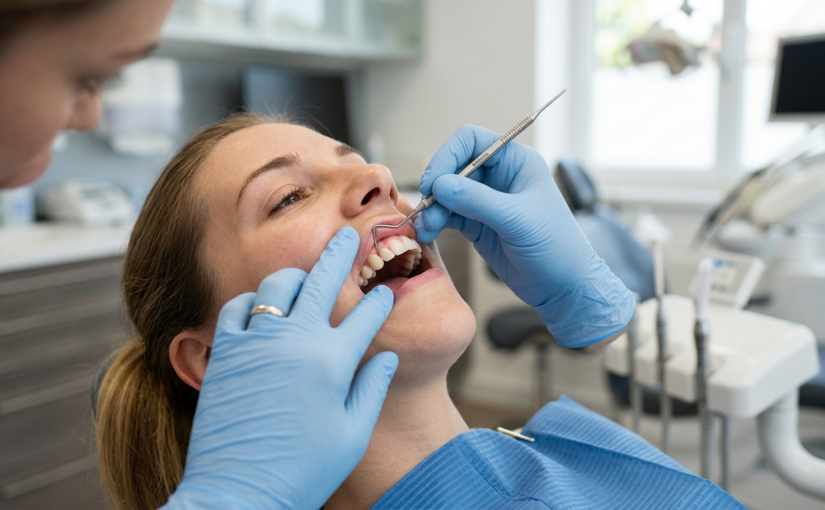
There is no single “gum treatment”. Bleeding gums treatment depends on the chart, and the chart is the first appointment.
| Stage | What happens | What to expect |
|---|---|---|
| Visit one | Pocket depth measured around every tooth, bleeding points and recession recorded, radiographs taken | This is what separates gingivitis from periodontitis. No honest quote is possible before it |
| Gingivitis | Professional scaling and polishing, corrected home routine | Bleeding typically settles in one to two weeks |
| Periodontitis | Scaling and root planing, quadrant by quadrant, under local anaesthetic | Cleans below the gum line, takes longer than a routine clean. Reviewed at six to eight weeks |
| If pockets persist | Repeat instrumentation, local antimicrobial in selected sites, or periodontal surgery | Decided from the re-measured chart, not from the first visit |
| Maintenance | Recall every three, four or six months depending on risk | Periodontitis is managed, not cured. Stop attending and it returns |

Interdental brushes reach where a toothbrush cannot. Illustration.
What a periodontal pocket actually is
A pocket is the gap between the gum and the tooth root, measured in millimetres with a thin probe. One to three millimetres is healthy. Four or five suggests disease that needs treating. Six or more usually means bone has been lost, and the tooth is being held by less than it was designed for.
Two numbers matter more than the depth alone: whether the gum bleeds when probed, and whether the gum has receded. A 5 mm pocket that never bleeds is a different problem from a 4 mm pocket that bleeds everywhere. That is why the chart is repeated after treatment rather than judged once.
The first week after scaling and root planing
Root planing is not a gentle procedure, and the week afterwards catches people out. Teeth can feel sensitive to cold for a few days. Gums may bleed a little while brushing for the first week, which is the inflamed tissue settling rather than a sign something went wrong.
Brush as normal on the day after treatment, gently at the gum line. Use the interdental brush or floss you were shown, even if it bleeds, because the point is to keep the pocket clean while it heals. Take pain relief only if you need it, and avoid very hot or very cold food for two or three days.
Call the clinic if you have bleeding that will not stop, swelling that increases after day three, a fever, or a tooth that feels loose. Those are not expected recovery findings.
How often a professional clean is actually needed
Twice a year is a reasonable default for a healthy mouth, and it is not a rule that fits everyone. If you smoke, have diabetes, have had periodontitis before, or wear orthodontic aligners, three to four months is the interval that keeps the disease from returning.
The evidence here is practical rather than dramatic: the patients who keep their teeth are the ones who return on the interval they were given, not the ones who book a cleaning once a year and hope. That recall interval is part of bleeding gums treatment, not a separate favour to your dentist.
Home care that actually changes the number
Brushing twice a day with a soft brush and fluoride toothpaste is the floor, not the goal. Soft bristles clean the gum line better than hard ones, and pressure matters more than the brush does.
Interdental cleaning is where most people fall short. Floss where teeth touch tightly, interdental brushes where there is a gap. If flossing makes your gums bleed in the first week, that is inflamed tissue responding, not a reason to stop. Bleeding usually drops sharply by day seven to ten.
Do not scrub a bleeding area with a hard brush, and do not avoid cleaning it. Both make it worse. Home care supports bleeding gums treatment; it does not replace it.
Gum disease is not only a mouth problem
Poorly controlled diabetes and periodontitis worsen each other, which is why we ask about HbA1c. There is an established association with cardiovascular disease, though whether the relationship is causal is still being studied. The NIDCR maintains a plain-language summary of the evidence if you want to read further, and the WHO oral health fact sheet covers the global picture. If you are pregnant, treating active gum disease is worth doing rather than deferring.
None of that is a reason to panic. It is a reason not to leave a bleeding gum line alone for two years.
Questions patients ask
Why do my gums bleed on one side only?
Almost always something local on that side: a crown margin, a wisdom tooth you cannot reach, or a chewing habit. One-sided bleeding needs an examination, not a different toothpaste.
Should I stop flossing because it makes my gums bleed?
No. Stopping is what caused the inflammation. Bleeding usually settles within a week or two of gentle, consistent flossing.
Can mouthwash fix this?
It helps as an addition, not a replacement. It does not remove plaque from below the gum line.
Will scaling loosen my teeth?
No. Scaling removes deposits, not tooth structure. Teeth can feel different for a few days because the calculus that was splinting them is gone. If a tooth was already loose, that was bone loss from the disease, not the cleaning.
Do I need antibiotics?
Rarely. Antibiotics do not remove plaque or calculus and they are not a substitute for instrumentation. They have specific uses, and routine gum treatment is not one of them.
Is bleeding gums a sign of vitamin deficiency?
Occasionally. Plaque is overwhelmingly the more common cause, so we rule that out first.
Booking
If your gums bleed when you brush, the useful next step is a periodontal examination, not a new toothpaste and not shopping around for bleeding gums treatment you may not need. At Luxe Dental Clinic in Velachery we chart the gums, take the radiographs that are actually needed, and tell you which stage you are in and what it will take.
Call or WhatsApp +91 99977 97777 to book. Mon–Sat, 10:00 AM to 8:30 PM.
Written and clinically reviewed by Dr. R. Sivaranjani, MDS (Periodontics), Tamil Nadu Dental Council Reg. No. 19729, practising since 2014.


Leave a Reply