
Dental Implants in Velachery
A dental implant replaces a missing tooth with a small titanium post fixed in the jawbone, topped with a natural-looking crown. Implants suit adults with healthy gums and enough bone. Dental implants are one of our clinic’s specialised services. Your implant dentist in Velachery is Dr. R. Sivaranjani, MDS (Periodontics), who has advanced training in implant dentistry. She plans each stage and fits your final teeth.
- ★ 4.9 Google rating
- Periyar Nagar, Velachery (near Phoenix MarketCity)
- Mon–Sat 10 AM – 8:30 PM
What are dental implants?
An implant has three parts. The implant is a screw-shaped post, usually titanium, that sits in the bone like a root. The abutment connects the implant to the crown. The crown is the visible tooth.
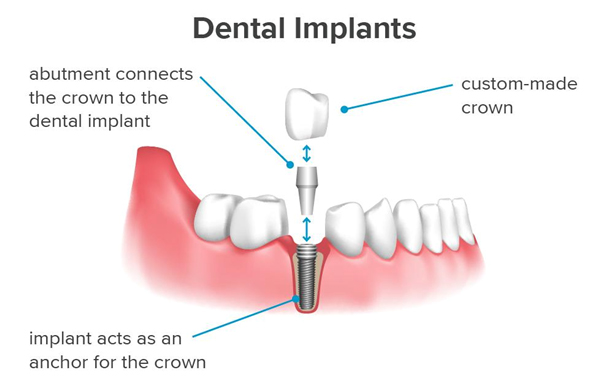
Over 3–6 months, the bone grows tightly around the implant (osseointegration). Then the final crown is fixed on. With good care, an implant can last many years.
Your options
- One missing tooth: one implant and one crown. The teeth on either side are not touched.
- Several missing teeth: two or more implants can hold a fixed bridge.
- All teeth in a jaw: a fixed set of teeth on four or six implants, often called All-on-4 or All-on-6. Or a removable denture that clips onto two or more implants. Read our All-on-4 vs All-on-6 guide.
Who is a good candidate?
Implants are for adults whose jaws have finished growing. Dr. Sivaranjani first checks:
- Bone: there must be enough bone to hold the implant. Bone shrinks after a tooth is lost. If it is thin, a bone graft may be needed first or at the same time.
- Gums: gum disease must be treated and under control first.
- Diabetes: well-controlled diabetes is not usually a barrier. Poorly controlled sugar slows healing and raises infection risk. Read about diabetes and oral health.
- Smoking: smoking raises the risk of the implant not fusing, and of gum problems around it later. We advise stopping, at least through healing.
- Health and medicines: tell us about blood thinners, bone medicines for osteoporosis, past radiation to the head or neck, or pregnancy. These can change the plan or timing.
Step by step at our clinic
- Consultation and planning X-rays. Dr. Sivaranjani examines your mouth and takes X-rays, including a full-mouth X-ray. These show the bone and the position of nerves and the sinus. You get a written plan and estimate.
- Preparation, if needed. Gum treatment, removal of a damaged tooth, or a bone graft.
- Implant placement. Under local anaesthesia, the gum is opened and the implant is placed in the bone. A few stitches close the gum. A small healing cap may show through the gum.
- Healing. Over 3–6 months, the bone bonds with the implant. If the gap shows when you smile, we will discuss a temporary tooth for this period.
- Uncovering. Once an X-ray shows the implant is firm, any gum covering it is opened under local anaesthesia.
- Crown. A mould is taken, and a dental laboratory makes the crown to match your teeth. It is fixed with a small screw or cement, and your bite is checked.
Is dental implant surgery painful?
Implant placement is done under local anaesthesia. Most people feel pressure and vibration rather than pain. Some soreness, swelling or bruising for a few days afterwards is normal. Prescribed medicines usually control it.
How many sittings do dental implants take?
| Stage | Visits | Typical time |
|---|---|---|
| Consultation and X-rays | 1 | Single visit |
| Gum treatment, extraction or bone graft | Only if needed | A graft can add a few months |
| Implant placement | 1 | Single visit |
| Stitch check | 1 | About 1–2 weeks later |
| Healing | Reviews as advised | Usually 3–6 months |
| Final crown | Usually 2 | Mould, then fitting |
Recovery and aftercare
On the day of surgery
- Bite gently on the gauze pad for 30–45 minutes. Light oozing on the first day is normal.
- Do not rinse, spit forcefully or use a straw today. This protects the blood clot.
- Hold a cold pack on your cheek for 15–20 minutes at a time, with breaks, to limit swelling.
- Once the numbness wears off, eat soft, cool food. Avoid hot drinks today.
- Take your prescribed medicines as advised. Rest, and avoid heavy exercise for a few days.
- Do not smoke or drink alcohol.
- Do not touch the area with your tongue or fingers.
From the next day
- Rinse gently with warm salt water after meals, or use the mouthwash we prescribe.
- Brush as usual, gently near the implant, with a soft brush.
- Swelling usually peaks on day 2–3, then settles.
- Wear a denture over the area only when your dentist says it is safe.
Clean around the final crown twice a day, like a natural tooth. Come for check-ups every 6 months, or every 3–4 months with gum disease or diabetes.
Risks and when to call us
Implants are a well-established treatment, and most heal well. Possible problems include:
- Early problems: swelling, bruising, bleeding or infection
- Implant not fusing: a small number do not bond with the bone. The implant is removed, and another can often be placed after healing.
- Nerve or sinus problems: rarely, numbness or tingling of the lower lip or chin, or sinus problems with upper implants. Careful planning lowers these risks.
- Later problems: gum infection around the implant (peri-implantitis), a loose screw or a chipped crown.
Call us if bleeding does not stop with firm pressure, or swelling worsens after day 3. Also call if you have fever or pus, numbness that does not wear off, or a loose implant or crown. You can call even after clinic hours; we will advise you and arrange the earliest appointment.
Dental implant cost in Chennai: what affects it
- The number of implants and teeth being replaced
- Any bone graft, extraction or gum treatment needed first
- The implant system and crown material
- Single crown, bridge, full-arch teeth or implant-supported denture, and any temporary teeth
We give you a written estimate after your check-up, before treatment starts. We accept cash, UPI and debit or credit cards. Ask us about payment options.
For typical starting prices and what they include, read our guides to dental implant cost in Chennai and All-on-4 and full mouth implant cost. Need several teeth rebuilt or replaced? See full mouth rehabilitation.
Why patients choose Luxe Dental
- Dental implants are one of our specialised services, from the first planning X-rays to your final teeth.
- Dr. R. Sivaranjani, practising since 2014, has advanced training in implant dentistry. Her MDS is in gum health (periodontics).
- One dentist sees you through, from planning to the final crown.
- Rated 4.9★ from 272 Google reviews (October 2026).
- In Velachery, near Phoenix MarketCity. Open Monday–Saturday, 10:00 AM – 8:30 PM.
Frequently asked questions
How long do dental implants last?
With good cleaning, no smoking and regular check-ups, implants can last many years. The crown may need replacing after some years because of normal wear.
How long do dental implants take to heal?
The gum over an implant usually settles in 1–2 weeks. The bone usually takes 3–6 months to bond with the implant before the final crown is fitted. A bone graft can add a few months. Most people go back to work within a day or two.
Am I too old for implants?
Age alone is not usually a barrier. Health, bone and gums matter more. Many older adults have implants, often to steady a loose denture.
Will I get my new tooth on the same day?
Usually not. The final crown waits until the implant has bonded with the bone, usually 3–6 months. Sometimes a temporary tooth can be attached sooner, if the bone allows.
What if I leave the gap?
Neighbouring teeth can tilt into the gap, and chewing gets harder. The jawbone there also slowly shrinks.
Implant or denture: which should I choose?
Implants are fixed, do not slip and help preserve the jawbone. Dentures need no surgery, cost less and are quicker to make. Read dentures vs dental implants.
Implant or bridge: which is better?
A bridge uses crowns on the teeth on either side of the gap, so those teeth are trimmed. It needs no surgery and is quicker. An implant replaces the missing root without touching the neighbouring teeth and helps preserve the jawbone, but it needs enough bone and takes a few months. If the teeth beside the gap already need crowns, a bridge can make sense; if they are healthy, an implant usually protects them better. Dr. Sivaranjani explains both options after checking your X-rays.
Can dental implants be removed?
Yes, a dentist can remove an implant if it is needed, but this is not common. The usual reasons are an implant that has not bonded with the bone, or severe infection around it. After the area heals, a new implant can often be placed. The crown on top can usually be repaired or replaced without removing the implant.
What is a periodontist, and why does it matter for implants?
A periodontist is a dentist with a postgraduate degree (MDS) in treating the gums and the bone that support the teeth. Implants depend on healthy gums and bone, both when they are placed and for years afterwards. Dr. Sivaranjani has an MDS in Periodontics and advanced training in implant dentistry, so she checks and treats your gums before and after your implant.
Related treatments
- Dentures, including implant-supported dentures
- Dental crowns and bridges
- Gum treatment to prepare for and protect implants
- Root canal treatment to save a tooth where possible
Book a visit in Velachery
To find out if implants suit you, book a consultation with X-rays and a written plan. Call +91 99977 97777, WhatsApp us or get directions.
Luxe Dental Clinic, No 3, 76A, Second Floor, Radha Mohan Street, Periyar Nagar, Velachery, Chennai 600042 (near Phoenix MarketCity). Open Monday–Saturday, 10:00 AM – 8:30 PM. Sunday closed. See clinic details, map and directions.
